

For years, employers have paid super quarterly.
From 1 July 2026, that changes.
Under the Government’s Payday Super reforms, employers must pay superannuation on payday, with contributions required to be received by the employee’s super fund within 7 business days of paying salary or wages.
1. The 7-Business-Day Rule
From 1 July 2026:
- Super must be paid each payday
- The contribution must be received by the fund within 7 business days
- Late payment may trigger the Superannuation Guarantee Charge (SGC)
Important: It is the date the fund receives the money, not the date you press “pay”, that determines compliance.
If your clearing house or payroll provider takes several days to process payments, you could unintentionally breach the rule.
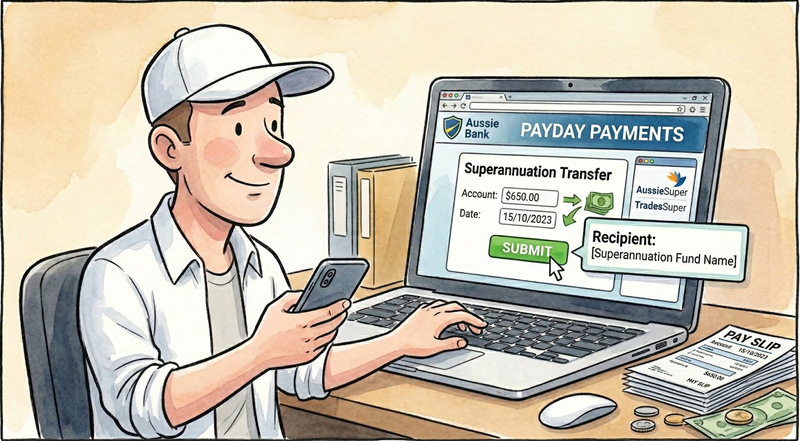
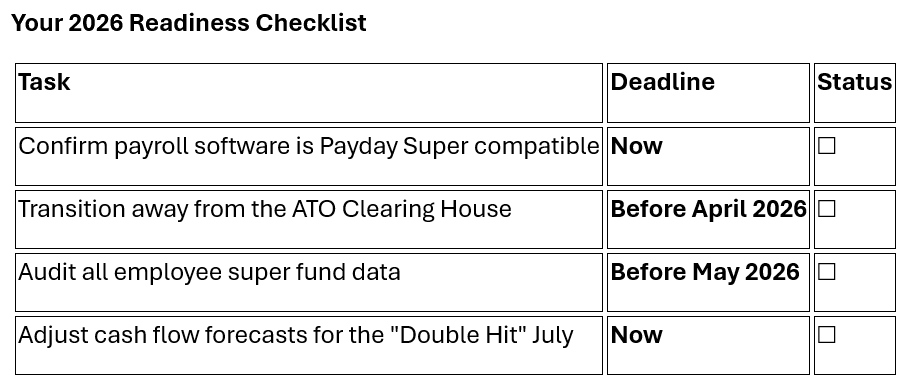
The ATO Small Business Superannuation Clearing House (SBSCH) will close from 1 July 2026, so employers must transition to a commercial solution.
2. The Cash Flow Impact (“The Buffer Is Gone”)
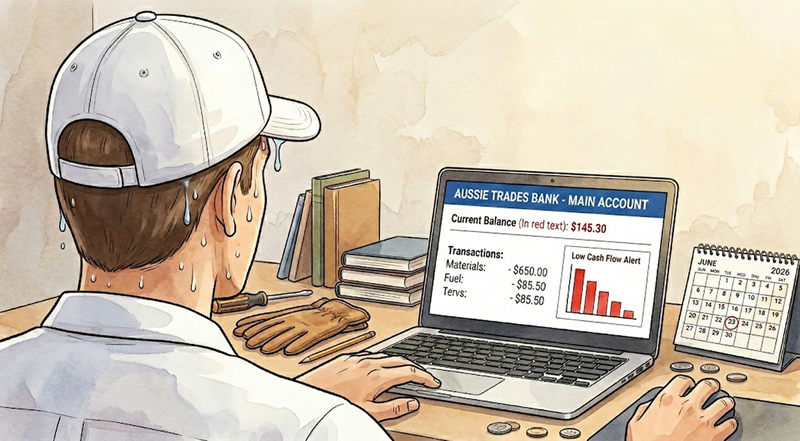
Currently, employers can hold super cash until quarterly due dates as working capital buffer, especially if operating on tight margins.
From July 2026, super will leave your bank account every pay cycle.
Example:
If your quarterly super is $15,000, you’ve had the benefit of that cash for up to 90 days. Starting July, that amount will be withdrawn from your account in smaller increments every week or fortnight.
This removal of a long-standing working capital buffer can cause cash flow problems.
Planning steps:
- Start modelling super per pay run now
- Adjust forecasts for July 2026
- Review pricing and margins if necessary
⚠️ Watch for July 2026
You may still have a final April–June 2026 quarterly super payment due under the old system, while also starting Payday Super obligations for July wages.
That can create a one-off cash flow spike.
3. Reporting Changes: Qualifying Earnings (QE)
Payday Super introduces a new concept: Qualifying Earnings (QE).
QE replaces Ordinary Time Earnings (OTE) as the basis for calculating super under the new framework.
Employers will report QE amounts year-to-date via Single Touch Payroll (STP) each payday.
This means:
- Payroll codes must be mapped correctly
- Employee super data (TFN, USI, member numbers) must be accurate
- Errors may lead to rejected payments and late-payment risk
The ATO will data-match STP reporting with fund reporting more closely under the new system.
“Fixing it later” will become much harder.
A Note from Tally Ho Accounting:
July 2026 might feel far away, but for a business with 5+ employees, the transition takes time.
We are currently helping our Sydney clients run “stress tests” on their payroll to ensure they aren’t caught off guard.
Don’t wait for the July deadline.
Would you like us to review your current payroll setup to see if you’re ready for the switch?
|
Need help right now? Contact Tally Ho Accounting today. Phone: 0451 637 848 Email: [email protected] |
Disclaimer: This blog is for general information purposes only and does not constitute legal or tax advice. DPNs are complex legal matters; please contact us for advice specific to your situation.