
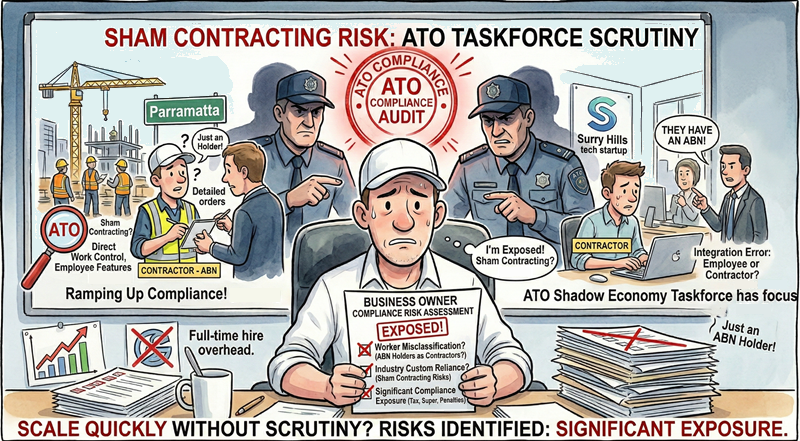
In the bustling Sydney business scene—from construction sites in Parramatta to tech startups in Surry Hills—flexibility is king. Engaging “contractors” is often the go-to move for business owners looking to scale quickly without the overhead of a full-time hire.
But there is increasing scrutiny.
The ATO’s Shadow Economy Taskforce has ramped up compliance activity, with sham contracting remaining a key focus area.
If you’ve been treating workers as contractors simply because “they have an ABN” or “that’s how the industry does it,” you could be exposed to significant compliance risk.
1. The High Court shift: It’s all in the paperwork
Recent High Court decisions have shifted the landscape. The written contract now carries significant weight in determining whether a worker is an employee or an independent contractor.
However, the contract must reflect a genuine independent contracting relationship. If your agreement labels someone a “Contractor” but the substantive rights and obligations resemble employment, regulators and courts will look beyond the label.
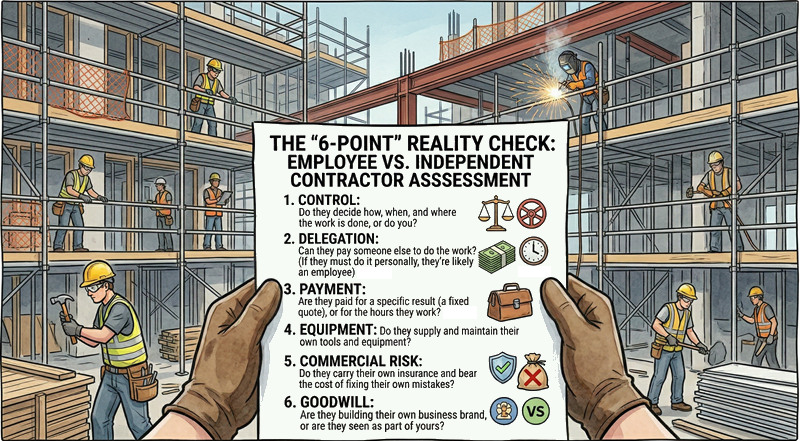
The “6-point” reality check
To assess risk, ask these questions:
- Control: Do they decide how, when, and where the work is done, or do you?
- Delegation: Can they pay someone else to do the work? (If they must do it personally, they’re likely an employee).
- Payment: Are they paid for a specific result (a fixed quote), or for the hours they work?
- Equipment: Do they supply and maintain their own tools and equipment?
- Commercial risk: Do they carry their own insurance and bear the cost of fixing their own mistakes?
- Goodwill: Are they building their own business brand, or are they seen as part of yours?
2. The “Super” Trap: Contractors may still require Super
Even if a worker is legally a “contractor,” you may still have a Superannuation Guarantee (SG) obligation if:
- The contract is wholly or principally for the worker’s labour and skills.
- The worker must perform the work personally (no right to delegate).
- The worker is paid for their time, not for achieving a specific result.
Failure to pay super can trigger the Superannuation Guarantee Charge (SGC), which includes the unpaid super, interest and administrative penalties.

3. The cost of getting it wrong
Misclassification can be expensive.
Potential consequences include:
- Civil penalties for sham contracting breaches
- Back payments of superannuation and, in some cases, leave entitlements
- Tax exposure where PAYG withholding obligations were incorrectly avoided
- Director liability for unpaid super in certain circumstances
How to protect your business
We recommend a proactive review before year-end.
Practical steps:
- Review ABN contractors — especially those engaged long-term or paid significant amounts.
- Review and update contracts — ensure they reflect genuine commercial arrangements, including delegation rights and defined deliverables.
- Assess super obligations — particularly for labour-only arrangements.
- Avoid industry myths — “Everyone does it this way” is not a legal defence.
|
Need help right now? Contact Tally Ho Accounting today. Phone: 0451 637 848 Email: [email protected] |
Disclaimer: This blog is for general information purposes only and does not constitute legal or tax advice. DPNs are complex legal matters; please contact us for advice specific to your situation.