

Welcome to 2026. While the property market continues to shift, the biggest risk to your bank balance this year isn’t just interest rates – it’s the tax office.
A number of property-related tax changes introduced over the last year are now fully in effect, and we are seeing many Australians caught out by rules they either misunderstood or ignored. On top of this, the ATO has significantly increased its compliance focus on property investors, particularly those with mixed-use or short-term rental properties.
Here is your survival guide for the year ahead.
1. The “foreign resident” rule is now catching locals
- The Rule: Foreign Resident Capital Gains Withholding (FRCGW).
- Status: Fully Enforced.
From 1 January 2025, the government removed the $750,000 threshold for foreign resident capital gains withholding. The result? A rule once seen as a “foreign investor issue” now affects almost every Australian property sale.
- The Reality for 2026: With a $0 threshold, sellers must generally obtain an ATO Clearance Certificate to avoid withholding tax at settlement.
- The Trap: Selling a $400,000 studio apartment or a vacant block of land? If you do not provide a Clearance Certificate by settlement, the purchaser is required to withhold 15% of the sale price and remit it to the ATO – even if you are an Australian resident.
- The Fix: If you are planning to sell property, apply for the Clearance Certificate early. We strongly recommend doing this before the property is even listed, so settlement proceeds are not delayed or reduced
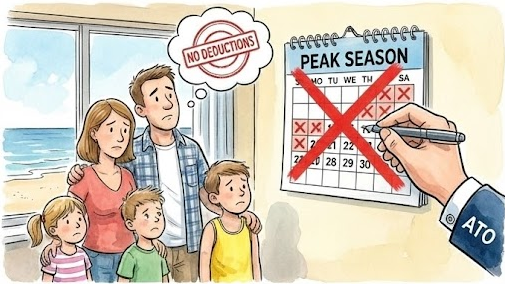
2. Increased scrutiny on holiday homes and mixed-use properties
- The Change: Not new law – but much stricter ATO enforcement
The tax law around rental property deductions has not fundamentally changed. However, the ATO has significantly increased its compliance activity and data-matching around holiday homes, short-term rentals, and properties with private use.
If you own a property that is rented out but also used personally (even occasionally), expect closer scrutiny in 2026.
The ATO is focusing on three key risk areas:
Availability for rent
If you block out peak periods (such as Christmas or Easter) for personal use, the ATO may argue the property was not genuinely available for rent during those periods. This can reduce the proportion of deductible expenses.
Below-market rent (“mates’ rates”)
Renting to friends or family at discounted rates limits your deductions. Expenses must generally be apportioned to reflect the actual rent received, not market rent.
High private use vs low commercial return
Where personal use is significant and rental activity is minimal, the ATO may challenge whether the property is genuinely income-producing. In these cases, deductions must be carefully apportioned in line with the property’s income-producing use.

3. A silver lining: Tax cuts arriving July 2026
It’s not all bad news.
As part of the 2025-26 Federal Budget, the Government legislated new personal income tax cuts that apply from 1 July 2026.
- The Change: The 16% marginal tax rate (for taxable income between $18,201 and $45,000) will reduce to 15% from 1 July 2026, and further to 14% from 1 July 2027.
- The Impact: This effectively lowers the tax payable on your rental income for that bracket, putting a little more cash back in your pocket for the 2026-27 financial year and beyond.
How we help property owners in 2026
The “set and forget” era of property investing is over. The ATO’s data-matching programs now cross-check information from sources including short-stay platforms, loan accounts, and property settlement data.
- Selling? We secure your Clearance Certificate to prevent the 15% withholding trap.
- Renting?We review usage, income, and expense records to ensure deductions are correctly apportioned and defensible.
| The Takeaway: Don’t let a paperwork error or misunderstanding of the rules cost you thousands. |
| Need help right now?
Contact Tally Ho Accounting today. Phone: 0451 637 848 Email: [email protected] |
Disclaimer: This blog is for general information purposes only and does not constitute legal or tax advice. DPNs are complex legal matters; please contact us for advice specific to your situation.